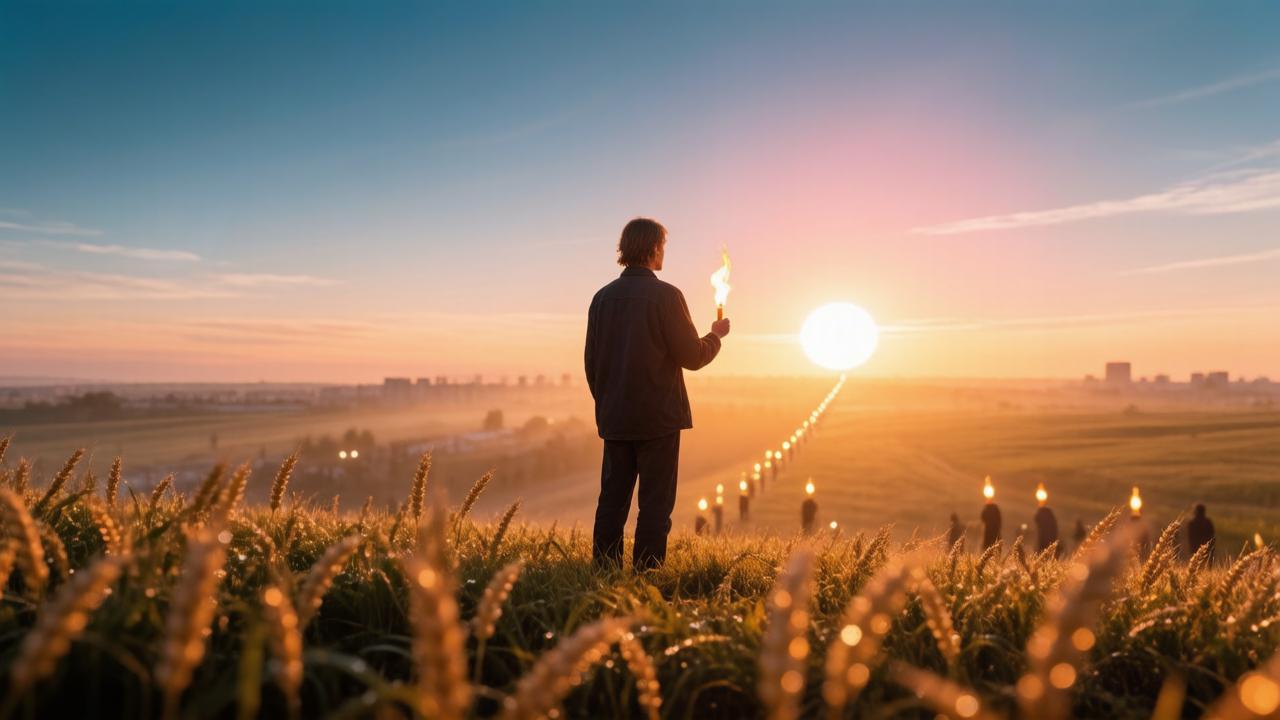
The Show Where We Were Given the Role of Spectators
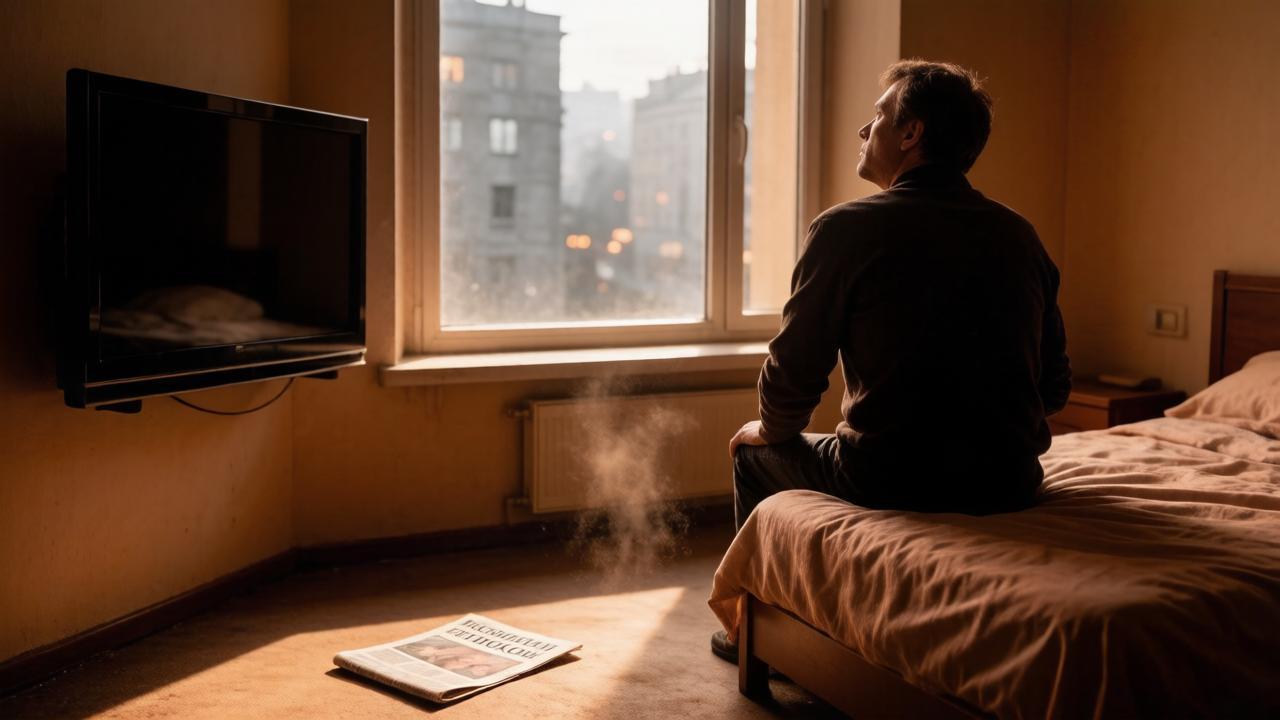
Why do you feel bad? Don't rush to answer. I'm not asking about the tiredness after work, or the money that doesn't last until payday, or the health that sometimes lets you down. All of that is understandable and familiar to everyone. I'm asking about something else — about that vague, aching feeling you push away in the morning when you stare at the ceiling and don't want to get up. It has no name, but it's there. And you know what I mean.
Maybe it's because you do everything right and there's still no result. You work, pay taxes, obey the laws, vote in elections — and still feel that nothing depends on you. That the decisions that shape your life are made somewhere out there, without you and not for you. It's as if you're playing a game whose rules were written by others, and you've been left the role of an extra. Nod, applaud, go home. And around it goes.
Maybe it's because they promise you things and then forget. Every few years people come with beautiful words, ask for your trust, get your vote — and disappear. They return only before the next election, with new promises. You no longer believe them, but you go anyway, because the alternative — not going at all — is even worse. So you live between disappointment and habit. And that too is not the answer to why you feel bad.
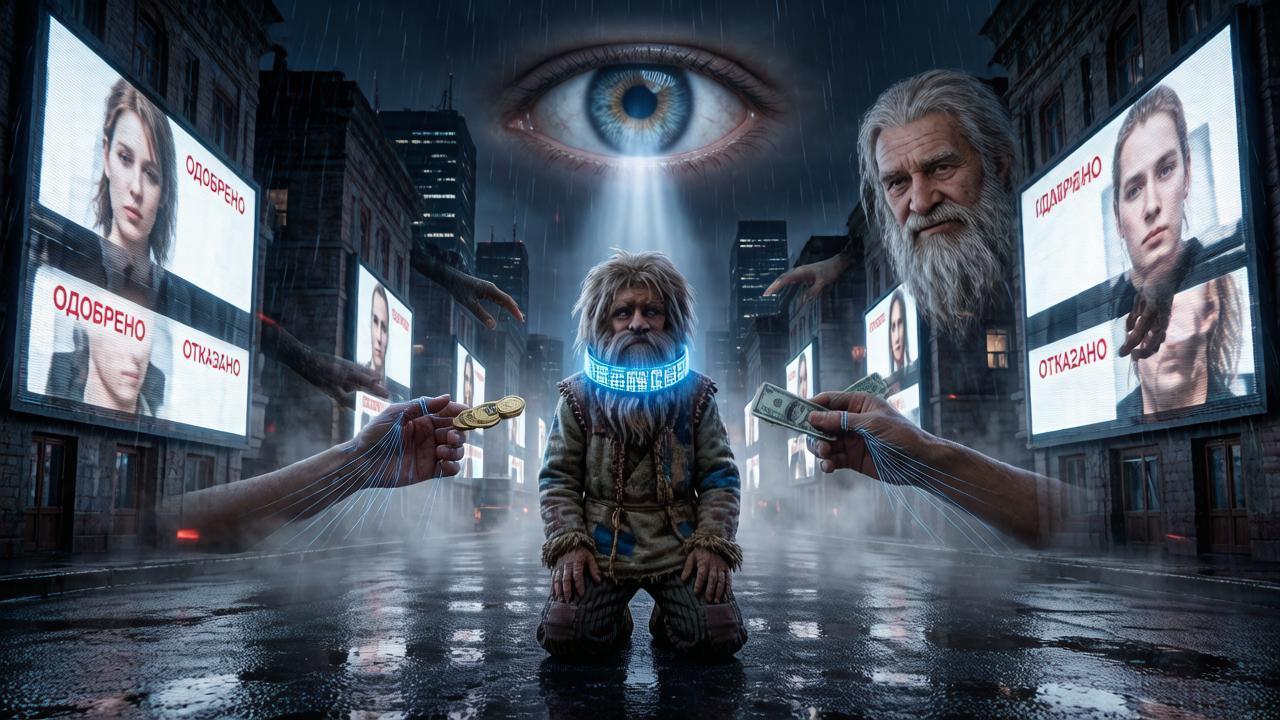
Maybe it's because you feel the space of freedom shrinking. Not sharply, not rudely, but softly and imperceptibly. First cash was cancelled in one place, then in another. Then they said the digital wallet was more convenient. Then they explained that certain purchases should be restricted — for your own safety. You didn't notice how you ended up in a system where every step leaves a trace and there is no way out. The collar is not put on by force — it is offered as a gift.
Or maybe it's because you are alone. Not in the sense of physical loneliness — there are people around, family, colleagues. But in the sense of the absence of a community where your voice means something, where you are heard, where you are not a function but a person. We have unlearned how to be together. We have learned how to be an audience. To watch, to scroll, to like, to buy. But not to decide. Not to influence. Not to build something common. And from this a void grows inside, which nothing can fill, no matter how many entertainments the system slips under your nose.
That is why you feel bad. Not because you are weak or lazy. But because you are a living person in a system that sees in you only a resource. Because your voice decides nothing, your money doesn't belong to you, and your freedom is a decoration behind which there has long been emptiness. You feel it, even if you can't put it into words. And this feeling is not an illness. It is a signal. It is your humanity, refusing to accept the role of a spectator.
This book is not a complaint and not a prophecy of the end of the world. It is an attempt to understand: how we got here, who and why is tightening the collar, and above all — what can be done. Not tomorrow, not someday, but now. Because there is a way out, and it is not in waiting for a saviour or rioting in a square. It is in building something else — from the bottom up, together, by honest rules. But before we talk about the solution, we must honestly name the problem. That is what we will do. Let us begin at the very beginning — with the show in which we were given the role of spectators.
Chapter 1
Theater of the Absurd: How Elections Became a Show
It all begins with a simple and honest admission that humanity made many centuries ago: the people cannot rule themselves. Too many people, too many different interests, too little time for agreement. So we agreed: we will choose those who will rule for us. Every few years we will come to a polling station, put a tick on a ballot, hand them power — and live in peace. The idea was beautiful. The problem is that the mechanism invented for the honest transfer of power long ago turned into something else.
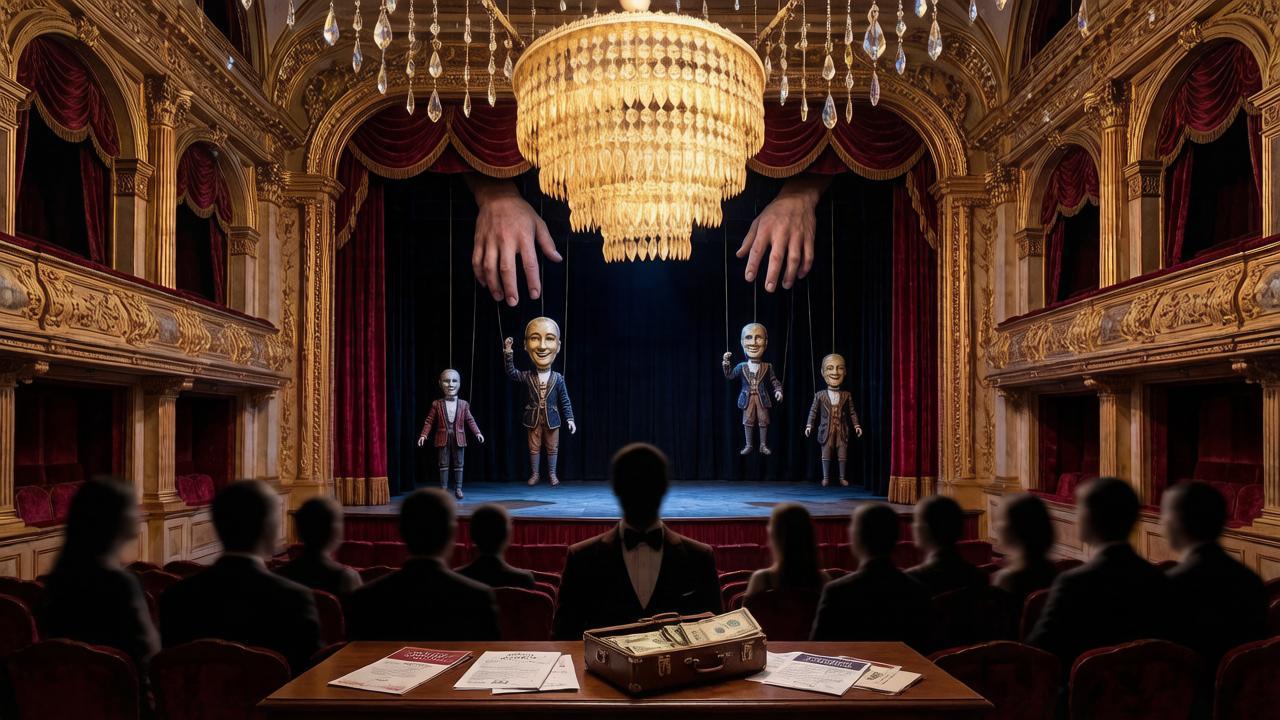
Look at an election campaign without bias, and you will see not a contest of programmes but a show. Slogans, tears to camera, pre-scripted scandals, revelations that surface exactly at the right moment. The winner is not the one with the better plan for the country, but the one with the better director, the louder voice, and more money for advertising. We vote not for ideas but for an image. Not for content but for packaging. And then we are surprised why nothing changes after the election. The answer is simple: because we chose not the one who would solve our problems, but the one who plays the part more beautifully.
And now let us look behind the scenes of this theatre. In the United States, lobbying is a legal profession. A corporation hires a person who walks the corridors of congressmen and "persuades" them to vote the right way. Not with arguments — with money for the next campaign. Pharmaceutical companies pay hundreds of millions so that drug prices don't fall. Weapons manufacturers — so that the military budget grows. And this is not underground corruption. It is an official business with offices, websites, and annual reports. All transparent. All legal. And it is precisely this that determines which laws pass and which are buried in committees forever.
Someone will say: that's a problem of one country, with us it's different. It is not different. The scenery changes, but the essence remains. Wherever power can be bought — by direct payment or through a campaign — it will be bought. Wherever a decision depends on one person, a queue of those who have resources will form. Not because all politicians are corrupt, but because the system is built that way. It rewards those who know how to deal with money, and squeezes out those who came with clean intentions. In a year or two, a clean person becomes the same as his predecessors. Or leaves.
The bitterest thing here is not that we are deceived. You can only deceive someone who believes. The bitterest thing is that we ourselves agreed to this role. We watch debates like a series and discuss candidates like characters. We wait for a "strong leader" to fix everything, instead of asking: why do we at all give someone the right to decide for us? Why does our voice disappear between elections? Why in the committees where important questions are decided sit not us, but those whom we never elected?
Representative democracy did not fail as an idea. It failed as a mechanism. The idea was that we elect the worthy and trust them. The mechanism turned out to be that we elect the one who sells better, and decisions are made by money. The system digests anyone who enters it — and only faces change. New faces, old rules. Fresh promises, the same result. This is the theatre of the absurd: everyone knows the play is staged, but they keep playing their roles, because no alternative is in sight.
But there is an alternative. And to see it, we must first honestly name the problem to the end. Not only that elections became a show. But that power disappears between elections — and along with it, we disappear too. That is what the next chapter is about. For now, let us remember the main thing: what is called democracy is increasingly turning out to be a play with a known ending. And that ending was written not for us and not by us.
Chapter 2
The Vanishing Voter: Power Between Elections
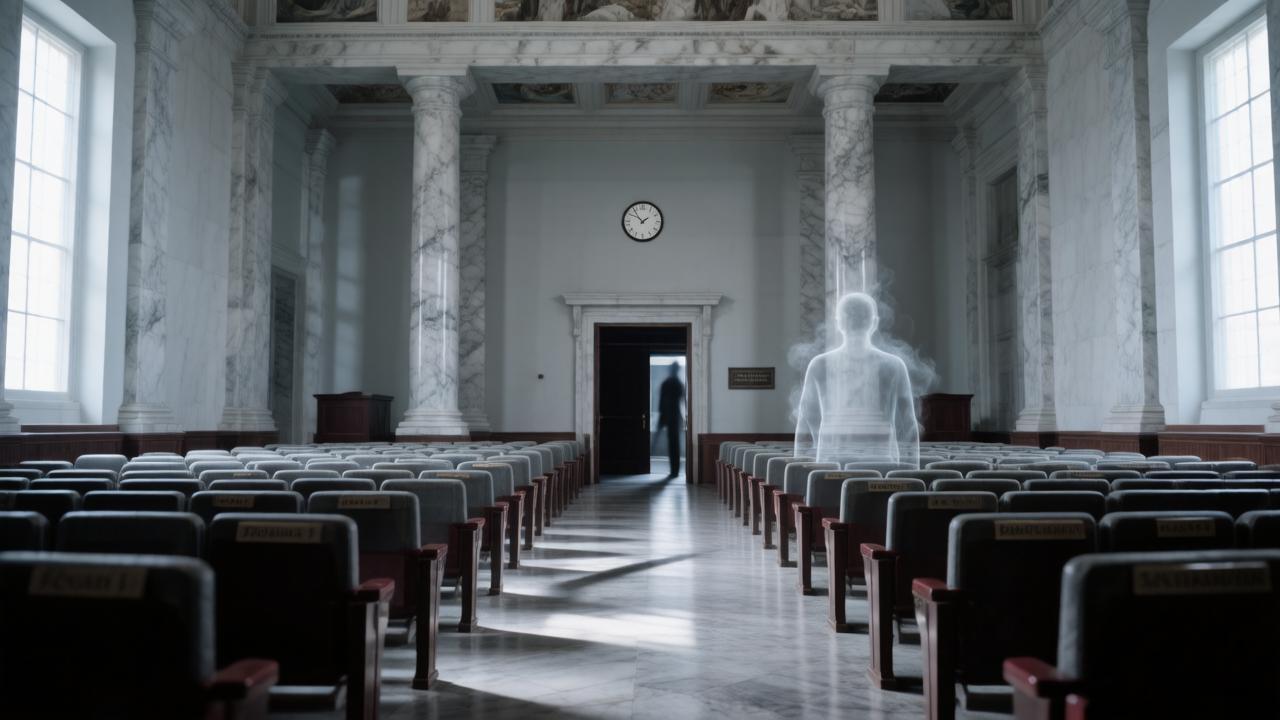
So the elections passed. The fanfares died down, the promises faded, the winners gave their speeches, the losers conceded. And silence came. That very silence in which the voter vanishes. No one remembers him. No one talks about him. No one addresses him. He becomes again what he was before the campaign — background. A taxpayer, an executor of laws, a source of resources. And so it will be until the next time, when he is once again taken out of the drawer, dusted off, dressed in a beautiful idea and asked to put a tick.
Think about it: where are you at the moment when a decision is made that will change your life? Not in the hall. Not in the office. Not in the committee. You are at work, on the subway, in the kitchen. You read the news that the tax has gone up, the tariff has been raised, the benefit has been cancelled, the law has been passed. You learn about the decision when it has already been made. They didn't ask you. They didn't discuss it. They didn't invite you to speak. They simply announced it — the way the weather is announced. Not because they forgot you. Because in this construction, you are not supposed to be there.
Between elections, power passes into the hands of those whom no one elected. Officials, advisers, experts, committees, commissions. They do not answer to the voter directly. You cannot send them home with a single vote. They sit in their places for years, for decades, and their decisions accumulate like layers of sedimentary rock. We live in a world built by these decisions — and almost never have a chance to challenge them. Voting once every four years is not power. It is an illusion of participation.
Someone will object: we have the opportunity to write petitions, go to rallies, demand. Yes, the opportunity exists. But it works as a safety valve, not as a lever. The system allows steam to escape so that it does not burst the boiler. You can write — they will politely thank you and reply with a formal brush-off. You can take to the streets — they will disperse you or simply wait you out. Nothing will change, because the mechanism of decision-making is not where you are addressing. It is closed. It is inside. And you are not invited in.
This is the real problem of representative democracy. Not that elections are rigged or candidates are liars. But that between elections you do not exist as a political subject. You turn into an object of governance. They work with you the way they work with the weather: they account for you, forecast you, regulate you. But they don't ask you. And when you realise this, that same vague feeling comes, the one we spoke of in the prologue. The feeling that you are not in your own life. That decisions were made for you somewhere out there, where you were not and will not be.
Can this be fixed from inside the system? Honestly — almost not. You can elect other deputies. They will come, collide with the same machine, and either break or fit in. You can change the party. Parties change, but the bureaucracy stays. You can demand reforms. The reforms will be written by the same people who are interested in nothing changing. The only thing that will really change is the faces on the screens. The mechanism will remain the same. And the voter will vanish again the day after the vote.
So the question must be put differently. Not "how to fix this system" but "how to build another one." Not "how to make power hear us" but "how to make power be ours." This sounds radical, but in fact it is simply a change of optics. We have tried for too long to repair what is broken not in the details but in the foundation. It is time to ask: what if participation should not end at the ballot? What if the voice can sound every day, and not once every four years?
That is where we are heading. But before we talk about the solution, we must deal with the second collar — the one that tightens imperceptibly, under the pretext of convenience. Because even if we return our voice but lose control over our money, freedom will turn out to be empty. That is what the next chapter is about.
Chapter 3
The Digital Leash: Why Convenience Is More Dangerous Than Chains
Remember how you were persuaded to move from paper documents to electronic ones. It's convenient, they said. No need to stand in queues, no need to carry folders, everything at hand, all in one place. That was true. But there was another side, about which they did not speak then. Today you cannot receive a service without the internet. You cannot confirm your identity without a smartphone. You cannot buy a ticket, book a doctor's appointment, or process a document if the system is unavailable. Convenience turned into dependence. And the same is being prepared for money — only the scale will be bigger.
Central bank digital currency is presented as the next step of progress. No need to carry a wallet, no need to count change, you can't lose cash, all transactions are protected. Sounds reasonable. But there is always something behind convenience. And here that something is a fundamentally new property of money, which it never had before. Cash is a thing. You can hide it, give it away, lose it, burn it. Digital currency is an entry in someone else's register. And this entry acquires what paper never had: programmability.
What does programmability mean? It means that money acquires properties that did not exist before. You can set an expiry date: you didn't spend it within a month — it burned. You can limit the area: spend only in your city, in your district, in your country. You can assign a purpose: these funds — only for food, and those — only for treatment. You can switch it off for an unacceptable statement on social media. This is not science fiction. These are technical possibilities that already exist and are being seriously discussed.
Imagine: the state decides that you are not sufficiently loyal. It does not put you in prison — that would be too crude and too noticeable. It simply cuts off your access to your account. Or restricts your purchases in your district. Or writes off part of your money as "unused." All legal, all technically possible, all explained by concern for your safety. That is why digital currency is called an electronic collar. It is not in your pocket — it is on your neck. And you can no longer take it off yourself.
The most dangerous thing here is the voluntariness at the entrance. They do not force you right away. They offer convenience, cashback, speed, security. Refusing is inconvenient, agreeing is pleasant. You enter yourself, by your own will, with the feeling that you have chosen the best. And then you discover there is no way back. Cash has disappeared, shops have switched to digital, services are available only through the system. And you suddenly understand: to live normally, you need to be inside. And inside you are no longer the master — you are a user who can be switched off.
Whoever owns this system owns everyone. Not in the sense of knowing your purchases, but in the sense of being able to control your behaviour. You can buy — but you cannot buy this. You can go there — but not there. Silence — is mandatory. This is the digital concentration camp that people increasingly talk about. Not necessarily with barbed wire and watchtowers. It is enough that money ceases to be yours. It is enough that every step of yours is recorded, and the system can at any moment decide that you do not deserve access to what you earned.
And here the two collars join. The first is political: your voice decides nothing. The second is economic: your money does not belong to you. Together they create total dependence. You cannot influence decisions — and you cannot leave the system that executes those decisions. You are locked in. Not in a prison, but in a convenient digital space where everything works as long as you are obedient. And this is far more frightening than open violence, because it does not look like violence.
But there is a way out. It is not in abandoning technology — that is impossible and unnecessary. It is in building another system. Where money is protected not by promises but by code. Where the voice cannot be bought, taken away, or switched off. Where a person is once again the master, and not the user. That is what the following chapters are about. For now, let us remember something simple: convenience for which freedom is given ceases to be convenience. It becomes a leash. And the softer it looks, the tighter it holds.
Chapter 4
New Wineskins for Old Wine: Why Technology Without New Substance Changes Nothing
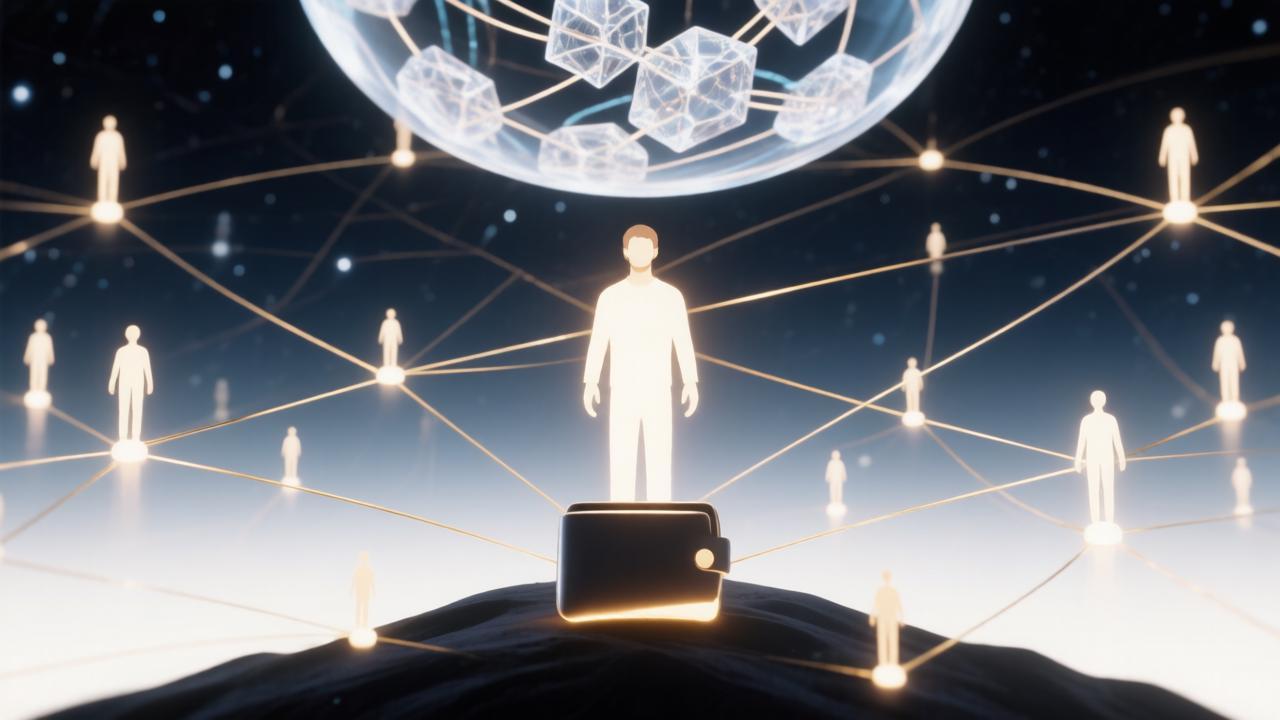
Before we talk about the solution, we must explain what a DAO and a blockchain are — in simple words, without terms. A blockchain is a shared ledger that thousands of people maintain at the same time. Every entry in it is visible to everyone, and it cannot be erased or forged, because a copy is stored with every participant. A DAO — a decentralized autonomous organization — is a community that lives by rules written into this ledger. No boss, no director, no deputy. There is code — and there are people who follow it. The rules are the same for everyone, and no one can change them alone.
It sounds like a dream. And that is exactly how it is sold. But here we must stop and look closely. The first DAOs, created after 2016, promised equality, transparency, the power of the community. What happened in practice? Large holders of tokens got the deciding voice. The rich became richer. The influential — more influential. Voting turned into an auction: whoever has more tokens determines the rules. People who came for freedom discovered that they had fallen into the same system, only with a different interface. The same money. The same power. The same hierarchy.
Here is the problem. Technology itself is neutral. A blockchain is just a tool, like a hammer. You can build a house with it, or you can smash a head. A DAO is just a form of organization. You can put equality into it, or you can put oligarchy. And most existing DAOs put the latter. They took the old anti-human rules of the game — where capital wins, where the strong subdue the weak, where power is bought — and transferred them into virtual reality. Nothing changed. It just now looks modern and is called a fashionable word.
Imagine an old woman who has had plastic surgery and now looks like Miss Universe. On the outside — young, beautiful, radiant. On the inside — the same old woman. The same illnesses, the same tiredness, the same proximity to the end. The operation changed the shell but not the essence. In exactly the same way, a blockchain can change the shell of an organization, but if the old principles, old greed, old inequality remain inside — we will get the same tyranny, only beautiful and encrypted. The collar will become digital, but it will remain a collar.
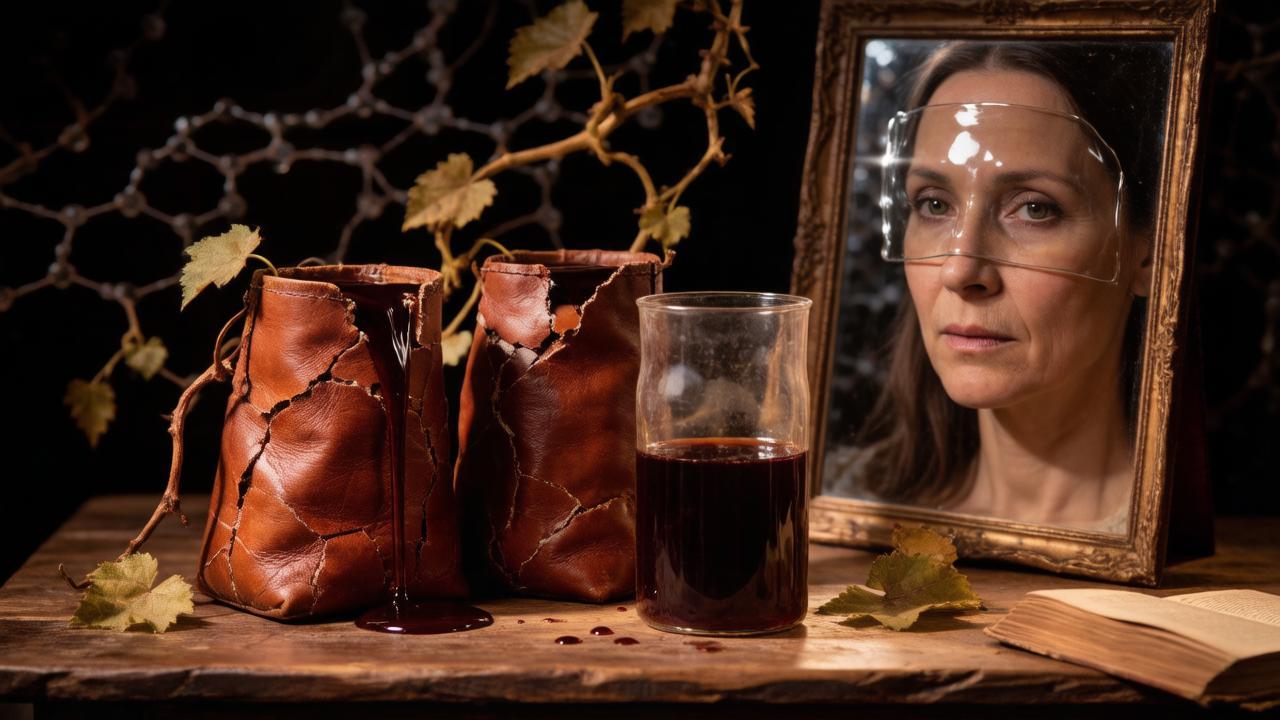
In the Bible there are the words of Christ: "Neither do people pour new wine into old wineskins. If they do, the skins will burst; the wine will run out and the wineskins will be ruined. No, they pour new wine into new wineskins, and both are preserved" (Matthew 9:17). The thought is brilliant and deep: new content requires a new form. You cannot pour fresh wine into old, cracked wineskins — they will not hold, they will burst, and everything will be lost. But let us rephrase it differently, even more precisely for our theme: "Neither do people pour old wine into new wineskins." You can build the most advanced technological form, but if you pour old, sour content inside — greed, hierarchy, inequality — the new wineskins will not save it. They will simply become a beautiful package for old poison.
That is why we cannot simply take existing DAOs and say: "Look, here is the solution." They do not solve. They repeat. They copy the old world, only in digital form. We need not just new wineskins. We need new wine. New substance. New principles that truly place the person above capital, equality above influence, community above the individual strongman. And that is where the hardest part begins. Because building a blockchain is engineering. But building new principles is the work of the soul and the mind, and it is not done overnight.
So what should be done? The answer will be in the following chapters. We must not simply use the technology, but rethink its very foundation. One person — one token, which cannot be sold. Four guilds, none of which absorbs the whole person. An economy of 49 to 51, where the entrepreneur gets an incentive but not power over people. These are not just new wineskins. This is an attempt to make new wine. But before building, we must honestly admit: old wine in new wineskins is what we have already seen. And it has turned sour.
Chapter 5
One Person — One Vote: How Equality Is Structured
Now let us move on to the most important part — how this works from the inside. Not in general words, but step by step. Imagine you have decided to enter. The first thing you do is download an app to your smartphone. You don't register on a website, you don't give data to a corporation — you receive a program that will store your identity with you, not on someone else's server. Then — a form and a video check. The system must be convinced that you are a living person with a document, that you are one and not ten accounts of one person. This is the key moment: without the uniqueness of the individual, no equality is possible.
After verification, you receive a cold crypto wallet — a device the size of a flash drive. Inside it is stored your private key. This is a mathematical code that confirms that the action was performed by you and by no one else. The key never leaves the device. Even if you connect it to an infected computer, the key stays inside. No one — neither the developers, nor the state, nor hackers — can sign something on your behalf. This is not a password that can be stolen. It is your digital signature, which cannot be forged. This is how the problem of trust is solved: you trust no one, you verify with mathematics.
Now about the most important thing — about smart contracts. A smart contract is a program that automatically enforces rules without human participation. Imagine a code of laws that executes itself. Voting has begun — the contract opens the reception of votes. Voting has ended — the contract closes it, counts the result, and publishes it. No one can interfere, twist, or recount. If the rules say that a token cannot be transferred to another, then it cannot be transferred. If it says that a vote is delegated and recalled at any moment, that is how it will be. Code does not lie. Code does not tire. Code does not take bribes.
Each participant receives one token. And here begins that which distinguishes our model from everything that came before. This token cannot be sold, bought, inherited, or taken away. The smart contract states: the token is bound to a unique personality and has no market value. A billionaire cannot buy a thousand tokens. An oligarch cannot pass his vote to his son. A corporation cannot buy up the votes of its employees. One person — one token — one vote. This is not a slogan; it is a technical property of the system. It does not depend on goodwill. It is built into the code and works automatically.
Next — delegation. You are not obliged to understand every question yourself. You can transfer your vote to someone you trust: a doctor — on medical questions, an engineer — on infrastructure, a teacher — on education. But this is not a refusal of the vote, but its temporary use. At any moment, with one click, you take the vote back. Delegation is formalised through a smart contract that records: to whom, for how long, on what topics. No one can hold your vote by force. This is fundamentally different from elections, where you give power away for years and then can do nothing.
Governance runs through four guilds. Professional — by occupation: doctors, teachers, programmers. Territorial — by place of residence. Corporate — by place of service. Thematic — by interests: ecology, culture, science, sport. In each guild you have one vote. This means that no single role absorbs the whole person. You are simultaneously a resident, a specialist, an employee, and a member of a community. Each part of life is represented separately, and none can subdue the others. This is protection against work becoming a prison, and a district becoming a camp.
All voting takes place on the blockchain. Every vote is recorded forever. You can at any moment check how you voted and how others voted, who proposed what, who spoke for what. Not after the elections, but in real time. This is not secret voting — it is transparent. Because secrecy is needed where people fear reprisal. But here reprisal is impossible: no person can deprive you of your vote. Results are not falsified, because they are counted not by a person but by code. The outcome cannot be rewritten, because a copy of the blockchain is stored with thousands of participants simultaneously.
Finally, the most important: in this system there are no bosses. There is code that is the same for everyone. There is a community that makes decisions. There are you — with an equal voice, with a protected wallet, with the ability to influence every day, and not once every four years. This is what equality looks like not in words but in technique. Not a promise, but architecture. Not faith in the honesty of power, but the absence of a power that needs to be trusted. That is what the next chapter is about: how this system creates an economy where you can be an entrepreneur but cannot become a master over people.
Chapter 6
49 and 51: An Economy Where No One Can Become a Master
Now let us talk about money. Because any system, however beautiful, collapses if it is based on an unjust economy. We are used to a world where the owner of an enterprise is the master, the shareholder is the lord, and the employee is a resource. Where some have power and others only duties. Where profit flows up and risk stays below. Our model proposes something else. And it begins with a simple principle: the owner, the shareholder, and the employee each have one token. One vote. They are equal.
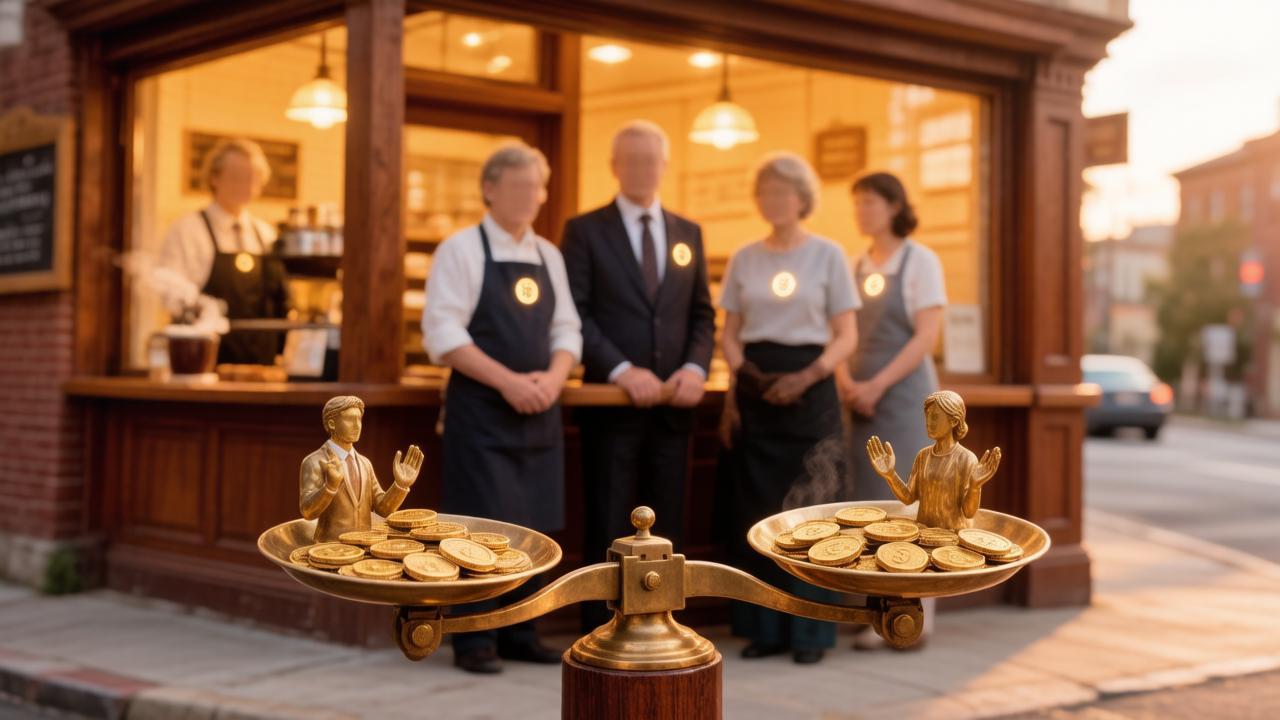
Imagine a coffee shop. Its owner invests money, time, soul. He takes risks, he develops, he hires people. He has an incentive — and that is right. Therefore he receives 49% of the net profit. This is his reward for labour, for risk, for entrepreneurial courage. He can grow, open new outlets, invest in equipment, improve the product. But 51% does not go to him. This money goes to the People's Welfare Fund — a common pot from which the basic consumer basket is financed for everyone: food, housing, healthcare, education.
Why 49, and not 50 or 40? Because 49% is enough to be an entrepreneur, but not enough to become a master over people. The owner cannot accumulate so much that he overwhelms the community. He cannot buy votes, because tokens are not for sale. He cannot dictate conditions, because his vote is equal to the vote of the cleaning lady. He remains important, respected, well-off — but not all-powerful. This is a balance that allows neither a slide into equalisation nor a return to oligarchy. The economy becomes honest not because someone is kind, but because the code is built that way.
And now — the most important thing, which must be said directly. The owner of the coffee shop has one token. The shareholder who invested money has one token. The barista at the counter has one token. The cleaning lady who washes the floor has one token. All of them are equal in the right to vote. But they are also all anonymous. The system knows that each of them is a unique living person with a document. It does not know who exactly. It does not know the name, the address, the position. Just — a person. One. With one voice.
What does this mean in practice? That no one can find out how the owner voted. No one can calculate who proposed changing the rules. No one can trace who supported the bill and who opposed it. Voting is transparent in result, but anonymous in authorship. The outcome is visible to all, but no face stands behind it. This is protection against pressure. Against revenge. Against bribery. Against a boss learning how a subordinate votes and firing him. Against a neighbour learning how his neighbour votes and starting a persecution.
In ordinary life this seems impossible. We are used to power knowing everything about us, and us knowing nothing about power. Here it is the opposite. The system does not know who you are. It only knows that you are a person, that you are one, and that you have a vote. Your purchases are not tracked. Your votes are not linked to your name. Your proposals are not signed by you. You influence — but remain invisible. This is not anonymity for the sake of anonymity. This is anonymity as a condition of freedom. Without it, equality turns into fiction: the one who knows can always pressure the one he knows.
That is why this economy works. The owner receives 49% — and he is content. The shareholder receives dividends — and he is calm. The employee receives a worthy salary and the basic basket — and he is protected. But none of them can rise above the others. No one can buy another's vote. No one can find out who voted how. The system is built so that greed does not pay off, and honesty is not punished. Not because people have become angels, but because the code does not allow them to become demons.
And here we must say the most important thing. The basic consumer basket is not a handout, not alms, not a social benefit that must be begged for. It is what belongs to a person by the very fact of his birth. Not because he deserves it, not because he is useful, not because he is loyal. But because he is a human being. Each of the eight billion people living on Earth has the right to food, to warmth, to shelter, to protection from hunger and cold, to safety during catastrophes. This is not a bonus for good behaviour. It is the starting condition of life, taken from the majority and appropriated by the minority.
Think about what this changes. A person who knows that he will not die of hunger, will not freeze in winter, will not be left without a roof over his head — this is another person. He is not afraid of losing his job, because he will not lose his life. He does not endure humiliations, because he does not depend on someone else's mercy. He does not sell his vote for a piece of bread, because the bread he already has. He becomes free not in words but in deeds. And then he remembers by whom he was created. In Psalm 81:6 it is said: "I said, You are gods; you are all sons of the Most High." Not kings, not the chosen, not the rich — all. Every human being is born in the image and likeness of the Most High, and therefore deserves not survival, but life.
That is what it means to be a human being with a capital H. Not the one who earned a lot, not the one who climbed the career ladder, not the one who won in competition. But the one who is aware of his original dignity and does not allow it to be taken away. The basic basket is not an economic mechanism. It is the recognition that a person is not a resource, not a function, not labour power. It is the material foundation for him to straighten up and remember who he is. Without it, all talk of freedom remains words: a hungry person does not think of higher things, he has no time. A fed person — can. A protected person — dares.
And here everything connects. The economy of 49 to 51 is not simply a way to distribute profit fairly. It is a way to return a person to his original position. When everyone has a basic basket, no one sells his vote for food. When everyone has one token, no one buys power for money. When all are anonymous, no one fears revenge. And when a person does not fear, he remembers that he is a child of the Most High, and not a cog in the system. Then greed loses its meaning, and honesty becomes natural. Not because someone forced it. But because the person has finally become himself. That is what the next chapter is about — the advisor who does not dictate but shows.
Chapter 7
An Advisor, Not a Dictator: AI That Shows Consequences
We have come to the last element of the construction — artificial intelligence. And here we must be extremely careful, because today people speak of AI either with horror or with naive delight. Some paint pictures of a machine uprising and the enslavement of humanity. Others promise that AI will solve all problems and lead us to paradise. Both are extremes. In our ecosystem, AI has a concrete, strictly limited role. It does not rule. It does not vote. It does not decide. It is an advisor-visualiser. Its task is to show consequences, not to choose for us.
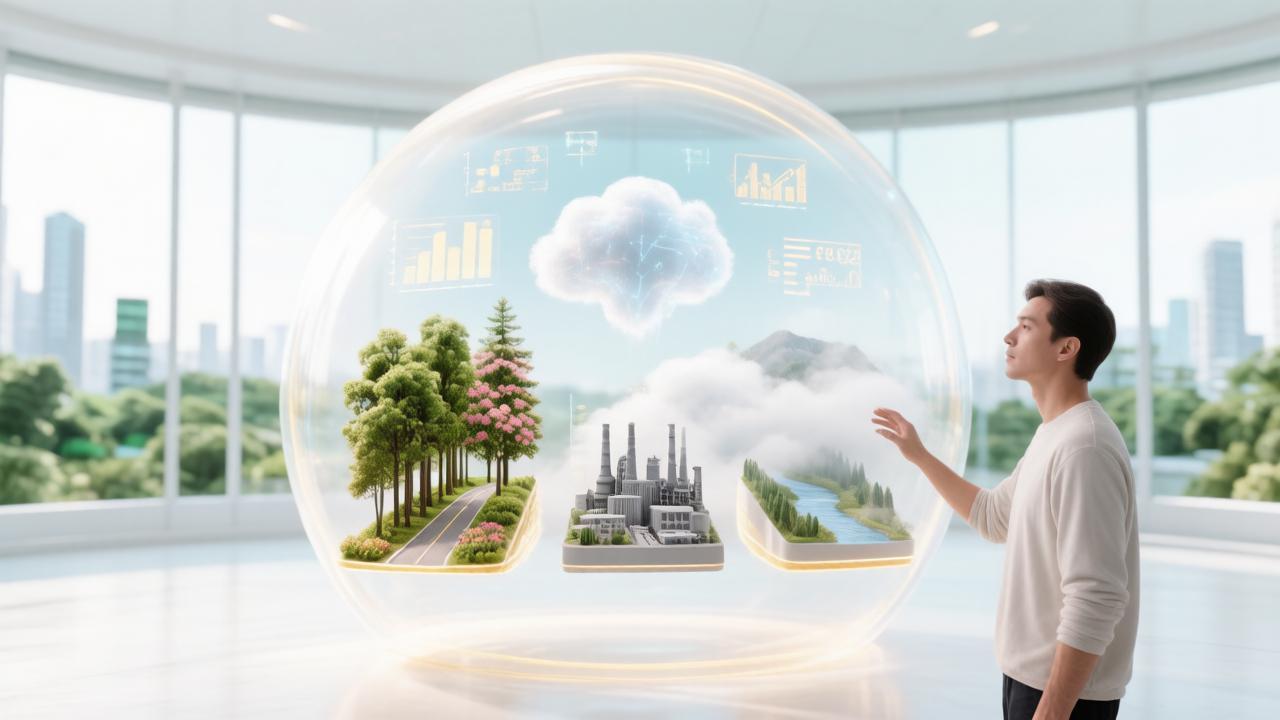
Imagine that you propose a bill. Suppose, to build a road through a forest. In the usual system, you vote blindly: someone says it's development, someone says it's the destruction of nature. You choose a side based on emotions, slogans, trust in the speaker. And then, ten years later, you discover consequences that no one foresaw. Here it is different. You submit a proposal — and AI shows you a model. Here is what will happen to the forest. Here is how the air will change. Here is how much road maintenance will cost. Here is which animals will disappear. Here is who will be better off and who will be worse.
This is not prophecy and not an order. This is simulation. AI does not say "Do this" or "Don't do this." It says: "Here is what will happen if you do this. Here is what will happen if otherwise. Here is what will happen if you do nothing." The future is shown as the present — visually, clearly, with figures and pictures. You see the whole picture, and not a fragment that someone finds it advantageous to present to you. And only after that you vote. Consciously. With open eyes. Not believing on someone's word, but seeing with your own eyes.
Someone will ask: won't AI manipulate us through these simulations? After all, whoever builds the model can tweak it to show the desired result. The answer is simple: the AI in our system is open. Its algorithms are visible to all. Its data are verifiable. Its models can be contested, alternative ones proposed, discussed. It is not a black box but a transparent instrument. And most importantly — it has no right to vote. Its recommendations decide nothing. People decide. Anonymously, with equal rights, by one token each. AI merely supplies information — the decision remains with us.
Here is the fundamental difference between an advisor and a dictator. A dictator says: "Do this, because I know better." An advisor says: "Here are the options, here are their consequences, choose yourself." A dictator hides information in order to govern. An advisor reveals it so that you can govern yourself. A dictator fears questions. An advisor answers them. The whole power of AI in our ecosystem is not that it is smarter than us, but that it counts faster, sees wider, and does not tire. But the goals are set by us. The values are chosen by us. The future is built by us. It merely shows the road.
Imagine how the quality of decisions changes. Today laws are adopted on the basis of lobbying, emotions, momentary gain. Tomorrow — on the basis of simulated consequences. Today a politician promises to cut a tax to please voters, and a year later the budget is cracking at the seams. Tomorrow the voter himself sees: here is who will be better off, and who will be worse, here is what will happen with hospitals, schools, roads. And he votes, understanding the price. This does not make us infallible. But it makes us sighted. And a sighted person does not walk where a cliff awaits him.
And here the whole construction closes. We have equality — one person, one vote. We have protection — anonymity and an untouchable token. We have an economy — 49 to 51, the basic basket by right of birth. We have technology — blockchain and smart contracts. And we have an advisor — AI that does not dictate but shows. All of this together is not a utopia. It is an engineering task. A difficult but solvable one. And it must be solved not tomorrow but now. Because the old world is cracking at the seams, and the new one is not yet built. That is what the epilogue is about. About where to begin and what each of us should do.
Epilogue
The Dawn Begins With One
We have gone the whole way — from diagnosis to solution. We saw how elections turned into theatre, how the voter vanishes between votes, how the digital leash tightens under the guise of convenience. We examined why old DAOs copy old rules and found that we need new wine, not just new wineskins. We described how equality, economy, and the AI advisor are structured. Now — the most honest part. All these technologies exist. But none of them is assembled into what we need.
Blockchain exists — but it is used for speculation and memecoins. Smart contracts exist — but financial pyramids are written into them. Cryptography exists — but it protects other people's fortunes. Artificial intelligence exists — but it serves corporations and advertising. All of this is scattered like construction kit parts in different boxes. Some technologies are ready and working — they need to be taken. Some need to be tweaked, refined, adapted to new principles. And some — written from scratch, because nothing like it has yet been created. This is not the task of one person. It is work for thousands.
But before assembling, we must awaken. All the technologies in the world are useless if the idea does not reach people. Today billions are asleep. They feel that something is wrong, but they do not know what exactly. They see the symptoms — poverty, dependence, powerlessness — but they do not see the diagnosis. Our task is to open eyes. Not to impose, not to shout, not to frighten. But to explain. Calmly, clearly, accessibly. To everyone who is ready to hear. Because it is said: a little leaven leavens the whole dough. We do not need to wait for millions. A few who have understood and carried it further are enough.
Spread the idea of popular sovereignty by all available means. Not only with articles — with kitchen conversations, social media posts, videos, podcasts, poems, songs, drawings. In any language that is understandable to your interlocutor. Because an idea is not a text but a spark. It lives as long as it is passed on. Silence kills it faster than any prohibition. Speak, argue, explain, answer questions. Do not fear mockery — fear silence. It is silence that has allowed the old world to remain in place for so long.
And now — the call. If you write code — join. If you are an economist, lawyer, sociologist, engineer, designer, psychologist, teacher — you are needed. If you know how to explain, organize, inspire — you are needed too. You don't have to be a genius. You just have to be someone who has decided that it's enough to be a spectator. This project is not for one country, not for one people, not for one era. It is the global cause of all ages and peoples, assembled here and now. And if you feel a response inside — then you are already part of it.
The dawn does not begin with millions. It begins with one person who woke up and woke a second. The second woke a third. And so on — until the darkness retreats. We do not promise it will be easy. We do not promise it will be quick. But we know: the old system is collapsing on its own, because it is inhuman. And the new one is being built by people who have remembered that they are gods, children of the Most High. Begin with something small. Today. With this page. With one conversation. The dawn is already near.